The Lumen Trap: Why the Brightest Torch isn’t Always the Best
When shopping for a torch, it’s easy to assume that a higher lumen count automatically means better performance. In reality, lumens only tell part of the story, a torch with an impressive lumen figure can still fall short if the beam isn't shaped for what you need.
Lumens measure total light output, not where that light goes. An 800-lumen torch with a focused lens can easily send light further than a 3000-lumen torch with broader lens. It’s important not to fall into the lumen trap, and to consider other measurements of lighting like candela and beam distance.
In this guide, we’ll break down the numbers that really matter and match each beam pattern to its ideal real-world use, so you can pick the right light for the job.
What do lumens measure?
Lumens measure the total amount of visible light a torch produces. They are the raw fuel of your torch, but they don’t tell you what that power is doing. Think of a garden hose with a multi-pattern nozzle. Whether you switch it to a wide cone or a tight jet, the exact same amount of water is coming out of the tap, it’s just being distributed differently. Light works the same way, different lenses simply shape that light into different beams.
Take two popular pocket torches from Fenixlight UK: the Fenix E28R V2.0 and the Fenix PD35 V3.0. Both output the exact same 1,700 lumens, yet the E28R V2.0 outputs a beam that reaches 273 metres, while the PD35 V3.0 uses a deeper reflector to focus that identical output into a tighter beam reaching 357 metres. Lumens tell you how much light you have; to know how far it travels, you need to look at candela.

What does candela measure?
Candela measures peak beam intensity, essentially, how tightly packed the light is at the brightest spot in the centre of the beam. Back to our garden hose, if lumens are the total amount of water coming out of the tap, candela is the power of the jet when you squeeze the nozzle down. The higher the candela, the more tightly focused the beam, and the further it will travel through the dark.
While both the Fenix E28R V2.0 and the Fenix PD35 V3.0 produce 1,700 lumens, the broader-focused E28R V2.0 generates 18,588 candela, whereas the tighter reflector on the PD35 V3.0 concentrates that same light to hit 31,900 candela.
In practical terms, candela dictates throw, which is how far a torch can project usable light. High-candela torches push light further into the distance, making them ideal for search and rescue or security patrols, whereas lower-candela lights prevent blinding glare and harsh hotspots during close-up tasks like DIY or dog walking.

Understanding Beam Patterns
Once you understand how lumens and candela work together, it’s much easier to recognize the three main beam patterns.
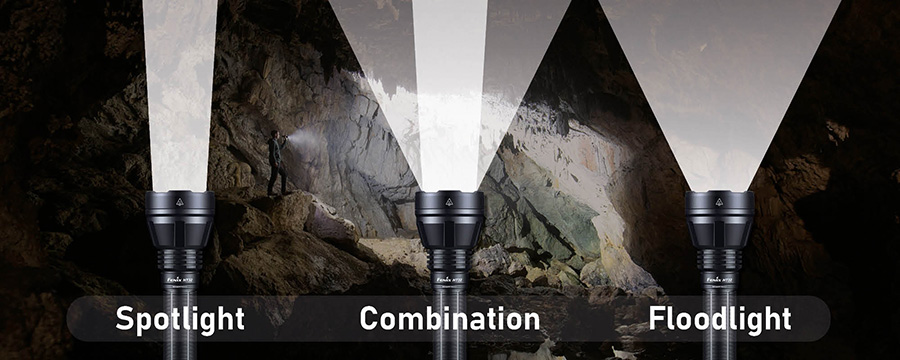
A floodlight beam prioritizes wide, even coverage over distance. Using shallow reflectors or textured optics, flood torches cast a broad wall of soft light with no harsh centre hotspot, making them ideal for camping, dog walking, DIY, and lighting up an entire room or garden at close range.
A spotlight beam does the exact opposite, using deep, smooth reflectors to funnel light into a tight, high-candela beam with minimal side spill. Built for maximum reach rather than peripheral vision, spot beams excel at search and rescue and security patrols.
A combination beam strikes the middle ground between the two, pairing a bright, focused centre hotspot with a wide ring of softer spill light around it. For EDC, hiking, and general outdoor use, a hybrid beam is usually the most versatile choice, giving you the best of both beams.
Choosing your Torch
Having the wrong light for the job can be frustrating, like using a tight spotlight to set up camp, or a wide floodlight when you’re trying to spot something in the distance.
Now that you know what the numbers mean, choosing the right torch is simply a case of matching the beam to how you plan to use it, rather than chasing the biggest figure on the box.
Every product across our lighting range includes a full breakdown of these technical parameters in the product description and user manual, so you don’t have to fall into the lumen trap.